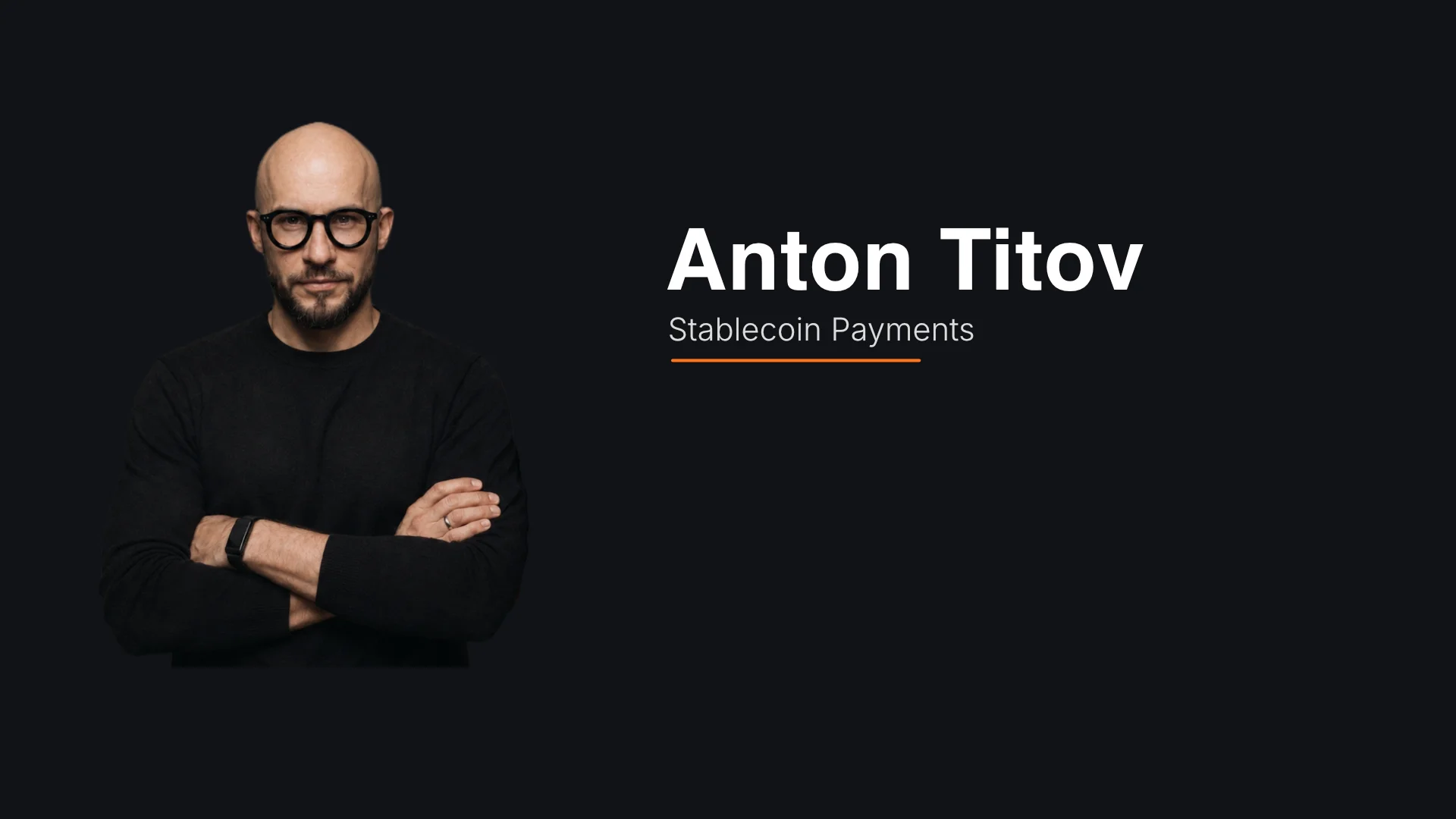
Anton Titov is a fintech entrepreneur and payments infrastructure executive with experience across cross-border payments, stablecoin settlement and digital asset infrastructure. Before co-founding Plexo, he worked on payment infrastructure at Archway Finance, where the company facilitated payouts across more than 30 corridors and his experience connecting stablecoin settlement with regulated local payment institutions exposed the operational challenges surrounding fiat access, counterparty relationships and compliance across markets. He now serves as CEO and co-founder of Plexo, a financial infrastructure company focused on coordinating transactions between regulated institutions across fiat and stablecoin payment rails.
In this interview with CryptoMegaphone, Titov discusses the distinction between stablecoin transfers and real-economy payments, the structural limitations of correspondent banking and bilateral payment relationships, the infrastructure and compliance gaps facing institutional adoption, and how stablecoins could become embedded within the broader global payments system.
You have worked across fintech, crypto and cross-border payments, including building stablecoin settlement infrastructure across multiple markets. What did that experience teach you about the problems stablecoins can genuinely solve — and where do you think expectations around them still run ahead of reality?
The most important lesson was that the stablecoin itself is usually the simplest part of a stablecoin payment. At Archway Finance, our infrastructure was based in Europe and we facilitated payouts into more than 30 corridors. Moving stablecoins across borders was fast and technically straightforward, but customers did not ultimately want stablecoins. They wanted Brazilian reais, Kenyan shillings, Nigerian naira or another local currency delivered on the other side.
That meant finding and onboarding a licensed local institution in every destination market. Most cross-border stablecoin payments are therefore a fiat sandwich: fiat enters through one licensed institution, a stablecoin crosses the border, and another institution converts it back into local money. The middle can move in seconds, while establishing, approving and operating the two endpoints can take months.
No company can economically own every on-ramp and off-ramp in the world. Even the largest payment networks depend on partnerships, and every new partnership means repeating counterparty discovery, contracts, KYB, compliance review, pricing, liquidity arrangements and technical integration.
Another misconception is that every on-chain transfer represents a payment. A transfer is not necessarily a transaction, and a transaction is not necessarily a payment. The same stablecoin can move as part of a customer payment, an exchange operation, a lending transaction, an internal treasury movement or a multi-step routing process.
A 2026 BIS Working Paper analysing 141 million Ethereum transactions involving USDT, USDC and PYUSD found that roughly one third involved multiple steps or greater computational complexity than a simple payment. Because complex transactions can generate multiple transfer events, they accounted for nearly 60% of all observed transfer events. That Ethereum study should not be treated as a description of the entire multi-chain payments market, but it demonstrates an important measurement problem: counting every stablecoin transfer as a separate payment is like counting every movement of a container inside a port as a separate shipment.
This is why headline stablecoin volumes require context. McKinsey and Artemis estimate that, based on December 2025 activity, stablecoin payments were running at an annualised rate of approximately $390 billion, with B2B accounting for roughly $226 billion. A separate BCG and Allium analysis estimates approximately $350 billion to $550 billion of observable bilateral stablecoin payments for goods and services in 2025. Those estimates are very different from the tens of trillions of dollars in on-chain stablecoin transfer volume sometimes cited in discussions of payment activity.
This is simultaneously a reality check and a major opportunity. Stablecoin settlement already works, but what has not yet been built is the complete institutional network around it. Stablecoins are an excellent settlement instrument, but they do not solve counterparty discovery, local fiat access, compliance interoperability or operational coordination. That missing institutional layer is the problem we are trying to address with Plexo.
Stablecoins are increasingly discussed as an alternative infrastructure for moving money across borders. From your experience, what are the biggest structural inefficiencies in today’s cross-border payment system, and which of them can stablecoins realistically address?
Cross-border payments are still organised around chains of bilateral relationships. Each additional market can require another bank, payment institution, liquidity provider, contract, compliance review and prefunded account. Capital becomes trapped across multiple balance sheets, while neither the sender nor the recipient has a complete view of what is happening.
The correspondent banking network has also been shrinking. BIS data show that the number of active correspondent banks declined by roughly one fifth after 2011, even as the value travelling through the remaining network increased.
The money did not disappear. The bridges did.
This is particularly visible in emerging markets, where institutions may have genuine commercial demand but limited access to dollar liquidity or international correspondent relationships. IMF research finds that flows between emerging-market and developing economies represent the largest share of cross-border stablecoin flows by value. In absolute terms, Asia-Pacific and North America account for the largest volumes of stablecoin activity, while Africa and the Middle East, and Latin America and the Caribbean, stand out when stablecoin activity is measured relative to GDP.
These cross-border figures include more than identified payments, so they should not be confused with estimates of real-economy payment volumes. However, they show where the need is particularly acute. Stablecoin infrastructure is often originated in global financial hubs, but it solves some of its largest problems in emerging-market corridors.
Stablecoins are beginning to fill part of the vacuum created by correspondent banking because they compress the settlement leg and allow value to move without passing through several correspondent balance sheets. But they do not eliminate the need for regulated local endpoints. The emerging alternative to a traditional correspondent relationship may therefore involve partnerships between payment institutions, on-ramps and off-ramps combining local payment licences with crypto or VASP permissions.
The inefficiency is not simply that payments are slow. It is that the institutional relationships required to make them possible are rebuilt almost from zero for every new corridor.
Much of the stablecoin discussion focuses on issuance, reserves and regulation, while less attention is paid to the infrastructure connecting institutions, counterparties and payment corridors. As stablecoins move further into institutional finance, where do you see the most important infrastructure gaps today?
I describe today’s market as a city full of buildings but almost no roads. The banks, payment institutions, PSPs, exchanges, custodians and liquidity providers already exist. Some are small houses serving individual markets, while others are global skyscrapers. But finding the right counterparty, determining whether it can serve a particular corridor, reviewing it and coordinating a transaction remain largely manual.
This becomes a mathematical problem as the network grows. Ten institutions can create 45 bilateral relationships, 20 create 190, and 50 create 1,225. Bilateral integrations do not produce genuine interoperability. They produce more islands.
The banking industry faced a comparable coordination problem before SWIFT. In 1973, 239 banks across 15 countries came together around shared messaging because maintaining an expanding web of bilateral telex relationships no longer scaled. Stablecoin payments are approaching a similar point. We are in a pre-SWIFT moment for stablecoins.
The market does not primarily need another blockchain or wallet. It needs a neutral coordination layer covering counterparty discovery, reusable compliance evidence, transaction authorisation, status communication and operational closeout. Today, those functions remain scattered across emails, messaging applications, shared drives, spreadsheets and incompatible APIs.
Blockchains solve only part of this problem. A blockchain can prove that a stablecoin moved, but it sees only the on-chain leg. It does not explain which institutions collected and paid out the fiat, which commercial obligation was being settled, who approved the counterparties or under which compliance conditions the transaction occurred. This is the layer Plexo is designed to address by connecting those components into a single institutional flow.
The blockchain sees the stablecoin leg. Plexo sees the transaction.
Financial institutions considering stablecoin-based payments still have to navigate compliance, counterparty risk and different regulatory regimes across jurisdictions. From what you have seen, what remains the biggest practical obstacle to institutional adoption, and why has it proved difficult to solve?
The largest obstacle is not regulation in the abstract. It is the absence of interoperability in how institutions implement regulation. Almost every regulated financial institution collects the same fundamental information: corporate records, licences, ownership structures, UBO documents, passports, proofs of address, operating policies and transaction evidence. But every institution requests, names, formats and reviews those materials differently.
It is a compliance Tower of Babel. Everyone may be regulated, but everyone speaks a different compliance dialect. The consequence is that the same company repeatedly rebuilds and resends substantially the same compliance package, with documents exchanged through email, cloud storage, messaging applications and bespoke portals. An approval achieved with one counterparty provides almost no operational benefit when approaching the next.
One way to address this is to make compliance evidence permissioned, structured and reusable. That is the approach we are taking with Plexo: the underlying documents remain controlled by the institution but can be securely reused, refreshed and reviewed by multiple counterparties. This does not transfer or outsource compliance responsibility; every institution still makes its own decision.
What changes is the speed and quality of the review. Instead of beginning every relationship with an empty folder, the reviewer can start with structured evidence and a history of previous institutional review. The same principle extends to transaction-specific compliance: when a payment flow begins, institutions should not need to reconstruct the identity and operating context of every participant, but should be able to review the specific transaction against an existing, current and permissioned body of evidence.
Over time, multiple independent reviews can strengthen the network without removing the responsibility of any individual institution.
Banks, payment companies and crypto-native firms are increasingly converging around tokenized money and blockchain-based settlement. Do you expect stablecoins ultimately to compete with traditional payment networks, become integrated into them, or form a parallel financial infrastructure with a distinct role?
All three outcomes will happen, depending on the corridor and use case. In markets where correspondent banking works well, stablecoins will often become an invisible settlement option inside the existing financial system. Banks, card networks and payment companies will integrate them without asking the customer to interact with a blockchain. In underserved corridors, stablecoins will support payment routes that did not previously exist or were commercially impractical.
They will also create parallel infrastructure for tokenised assets, programmable treasury and round-the-clock institutional settlement. The future is therefore likely to be modular and multi-rail.
Cross-border stablecoin payments already do not live on one blockchain. BCG and Allium estimate that Tron carried approximately 60% of real-economy stablecoin payment volume by the end of 2025, down from about 74% at the beginning of the year, even as its absolute volumes continued to grow. Their analysis also indicates that incremental growth increasingly came from other networks, including BNB Chain, Ethereum, Solana and Polygon.
The distinction also depends on the type of transaction, with different networks developing different payment profiles based on factors including transaction costs, liquidity and the markets they serve. Stablecoins may share a currency, but they do not share the same passengers, routes or timetable.
For institutions, the important principle is therefore neutrality. They should not need to rebuild their relationships, compliance and operating processes every time the appropriate stablecoin, blockchain or liquidity provider changes.
At Plexo, we apply this principle by coordinating multi-leg transactions that can combine fiat collection, stablecoin settlement and fiat payout while allowing the participating institutions to settle directly. These should be understood not as unrelated transfers but as different regulated legs of one financial obligation involving multiple institutions, approvals and sets of compliance evidence.
Over time, the same coordination model could extend beyond payments. Liquidity or financing, for example, could become another coordinated leg of an institutional transaction where the relevant counterparties, compliance evidence and transaction terms have already been established.
Looking five years ahead, what would have to happen for stablecoins to become a routine part of global financial infrastructure rather than a specialized crypto product — and what do you think the market still misunderstands about that transition?
Stablecoins will become routine when they become operationally boring. A corporate treasurer should not need to choose a blockchain, inspect wallet addresses or negotiate separately with every institution involved in a route. The treasurer should choose the market, currency, amount, price and required delivery time, while the infrastructure underneath identifies the appropriate institutions, determines the available liquidity and coordinates the settlement rails.
That requires shared standards for institutional identity, compliance evidence, messaging, transaction status and exception handling. It also requires networks that can work across different stablecoins, blockchains, custodians, payment institutions and liquidity providers.
The rails may operate 24 hours a day, but the institutions using them still keep office hours. BIS research found distinct timing patterns among structurally simple stablecoin transfers: USDT and USDC activity was more aligned with European business hours, while PYUSD activity was more closely aligned with U.S. business hours. Weekend activity was also lower across all three. This shows that continuous technical settlement is not the same as continuous institutional availability.
The winning infrastructure will not force every participant onto one proprietary asset or rail. It will remain neutral and coordinate whichever regulated components are appropriate for the transaction. The internet became broadly useful when users no longer needed to understand the protocols moving every packet. Stablecoins will reach the same stage when the chain becomes an implementation detail and institutions primarily experience lower costs, greater reach and more reliable settlement.
At that point, people will stop talking about stablecoin payments as a separate category. They will simply call them payments.