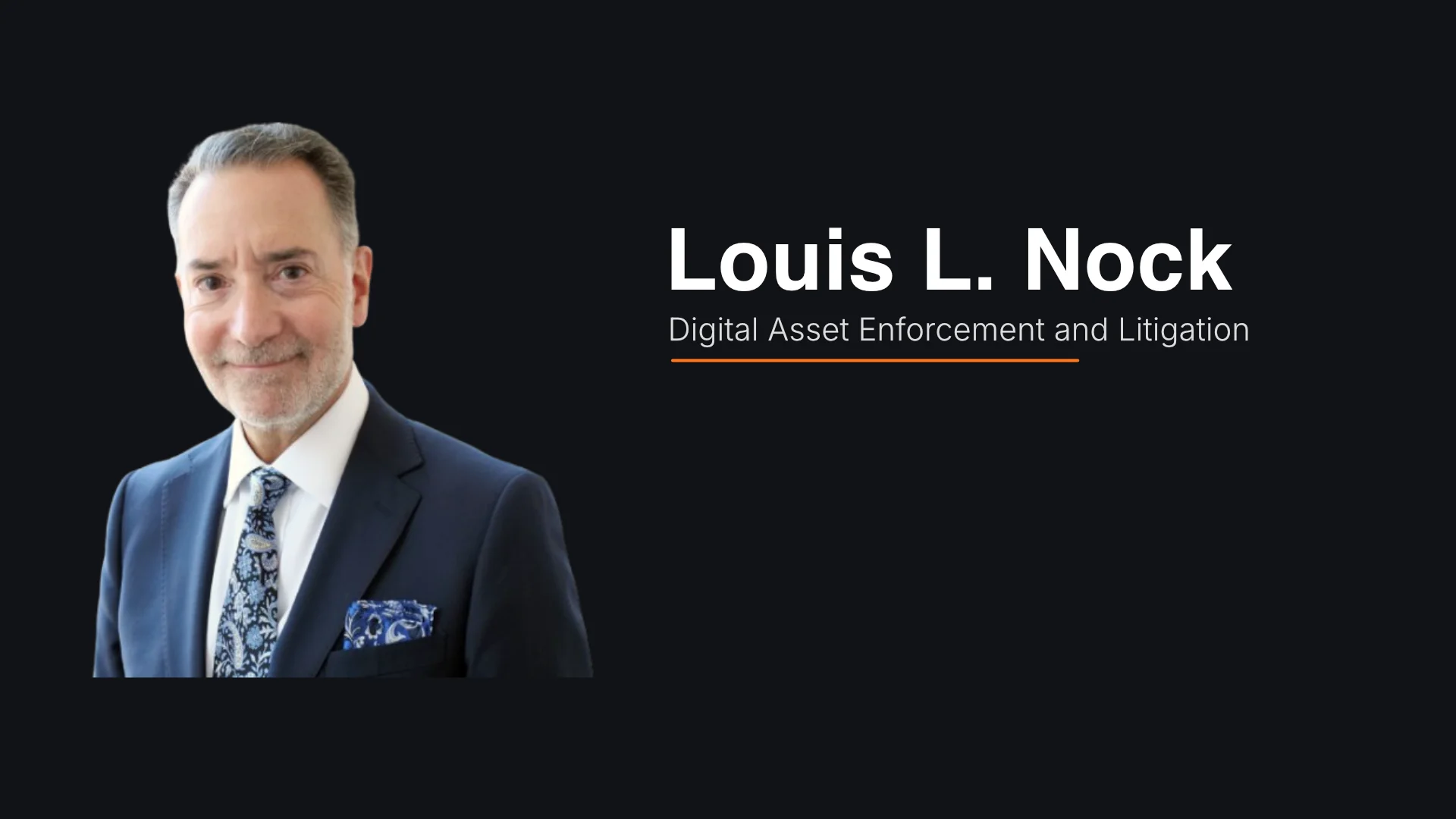
Justice Louis L. Nock, a retired Justice of the New York State Supreme Court and former presiding justice of the Commercial Division in Manhattan, has overseen complex commercial and corporate litigation matters. He is currently a shareholder at Anderson Kill P.C. in New York, where he focuses on complex commercial litigation, including matters involving digital asset markets, as well as arbitration and mediation.
In this interview with CryptoMegaphone, Justice Nock discusses jurisdictional challenges in digital asset disputes, the interaction between regulatory enforcement and private litigation, and how courts are integrating cryptocurrency-related claims into broader commercial jurisprudence.
In recent years, digital asset-related disputes have increasingly reached courts. From your perspective, what procedural or jurisdictional complexities tend to arise in these matters compared to more traditional financial cases?
As for your question, there definitely are nuances of practice that uniquely affect litigation in this area which are less prominent in traditional commercial litigation, and I have been practicing commercial litigation for over three decades. The most obvious, I would say, is the jurisdictional aspect of digital asset litigation. Jurisdictional questions are often geographically centric, meaning: where is the locus of the dispute, or where is location of the subject asset which, in Latin-legalese, we refer to as the “res” of the dispute? Because digital assets have no physical situs, that can become a thorny issue for courts to iron out.
The dilemma was dealt with head-on, and somewhat recently, by the Delaware Chancery Court – one of our country’s most respected corporate law courts, and one which I interacted with while presiding over my own commercial law court (New York State Supreme Court in Manhattan) – in the case of Timoria LLC v. Anis (346 A.3d 1166 [Del. Ch. Oct. 6, 2025]). That court endorsed the concept that the digital asset is “located” where its owner is domiciled – in that case, Delaware, because the owner of the Ether which was the subject of the lawsuit was a Delaware limited liability company.
My advice to clients has been to prefer contractual clauses selecting pre-determined arbitral forums for dispute resolution of digital asset matters. As a Lifetime Member of the PDSL International Mediation Institute & Chartered Institute of Arbitrators, and a New York County leader in settling cases from the Bench, I have seen up close how beneficial this can be for plaintiffs and defendants alike.
Another serious issue involves a court’s practical ability to temporarily restrain digital assets pending litigation on motions for injunctive relief. Whereas traditional assets can be traced to either a physical location or an actual bank account, cryptocurrency can be moved or dissipated in a matter of seconds or minutes before a court can even entertain such motions, especially in instances involving self-custodied “wallets.”
Judge, how do courts generally approach questions involving emerging financial technologies where statutory frameworks may predate the underlying innovation?
The prime responsibility of any court is to interpret statutes and, when necessary, expand the ethos of a particular statute to modern contexts which share the same concerns as the context in which the statute had its genesis. We look to the purpose of the statute. Of course, that raises other questions in the context of cryptocurrency that continue to occupy industry actors, as well as regulators; to wit, is it a security, or is it a commodity?
But, at bottom, in the face of statutory uncertainty, a court will resort to time-honored common law principles derived from the classic laws of contract, property, and tort, whether we are talking about smart contracts, decentralized platforms, or modern forms of digital value transfer.
To what extent do enforcement actions influence subsequent private litigation involving digital asset market participants?
I have found that courts will typically derive some measure of guidance from enforcement actions in order to better understand how regulators view the technology and the market which it serves. In fact, enforcement actions alleging fraud can tend to give rise to shareholder suits, consumer protection claims, and class actions by token buyers.
Quite apropos to the preceding question, I find that courts sometimes derive guidance from enforcement actions regarding the application of statutory law that predates crypto technology.
But when it comes to enforcement actions, I would recommend reviewing what I consider to be a seminal federal court decision out of Manhattan, where I practice and previously served as a judge, which lays out many fundamental facts and principles surrounding the regulation of cryptocurrency. That would be the 2024 enforcement action decision in Securities & Exchange Commission v. Coinbase, Inc. (726 F. Supp. 3d 260 [S.D.N.Y. 2024], lv granted, 761 F. Supp. 3d 702 [S.D.N.Y. 2025]), authored by Hon. Katherine Polk Failla, U.S.D.J.
Have you observed any evolving patterns in how compliance expectations are framed in disputes involving digital asset businesses?
At this point in the crypto trajectory, I have seen courts grow to view compliance obligations such as “Know Your Customer” and Anti-Money Laundering monitoring as business norms, irrespective of the fact that it involves digital asset technology. In other words, digital asset businesses have been increasingly expected to conduct monitoring and response planning. Plainly stated, the same or similar expectations that exist in regard to securities broker-dealers are being applied to actors within the crypto space. Claims are now sounding in theories of lack of compliance controls, negligence, and consumer fraud.
In matters involving novel asset classifications, how important is expert testimony in assisting judicial analysis?
Courts are increasingly relying on expert evidence to understand token issuance protocols and, critically, asset classification, i.e., is the digital asset functioning as a security or as a commodity? Is it currency in the ordinary sense or an investment? Topics addressed by experts can include identification of standard practices and avoidable risks.
Looking ahead, do you anticipate that litigation involving digital assets will become more specialized, or increasingly integrated into broader financial market jurisprudence?
Actually, I see it more as a common preference by courts to perceive digital asset litigation as just another, albeit evolved, manifestation of established commercial jurisprudence. This perception is in line with what I talked about in response to your earlier question about the expansion of tried-and-true legal principles to the modern factual or, more particularly, technological, context. That said, there will necessarily be those situations where specialized know-how becomes indispensable, such as matters involving Decentralized Finance and Algorithmic Stablecoins. But again – fraud and consumer protection causes of action, in the main, will rest upon sound application of established principles.