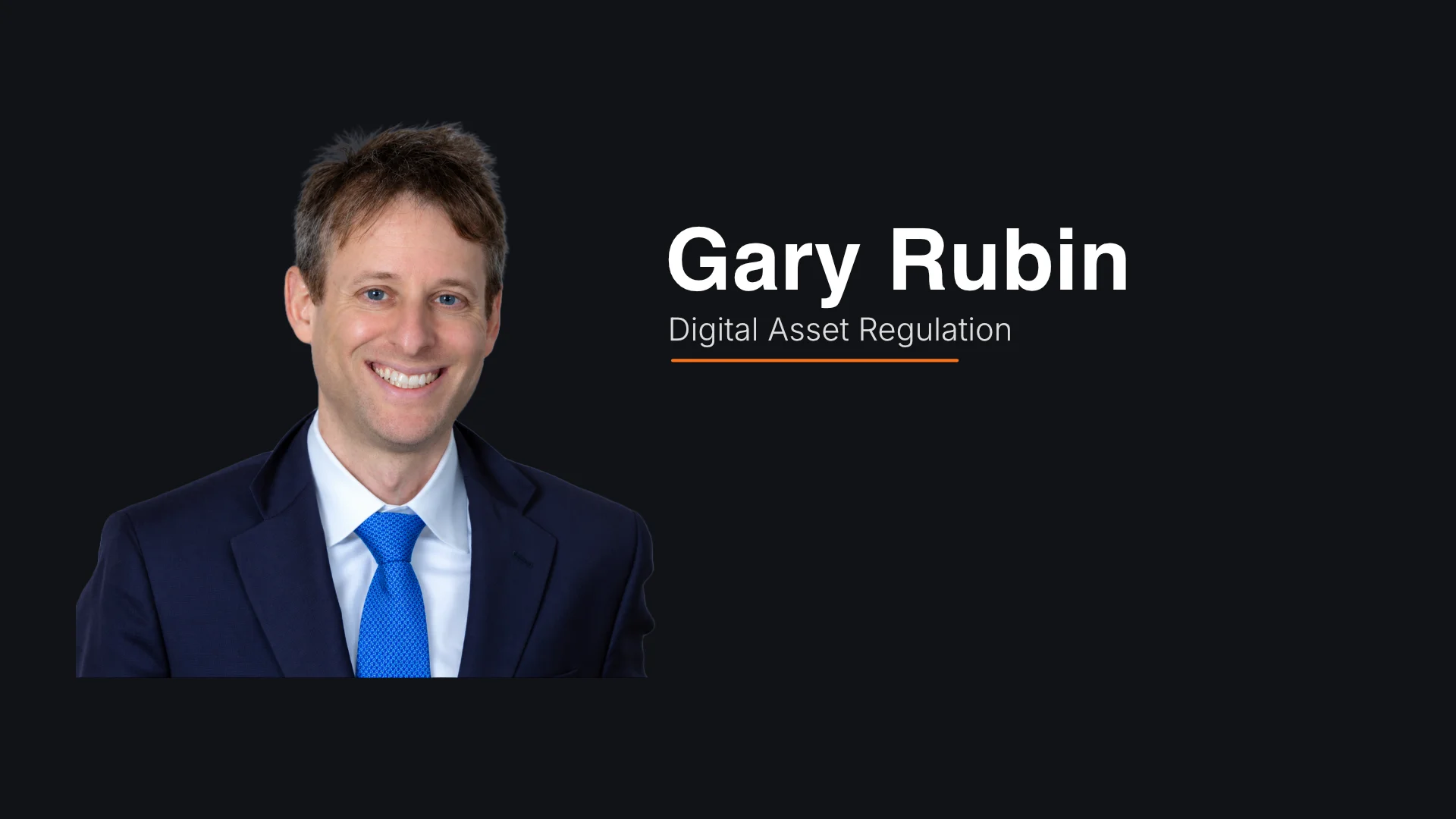
Gary Rubin is a financial regulatory and policy consultant with experience across U.S. financial regulators, government and the private sector. He previously served as deputy head of regulatory interpretations at Wells Fargo and held roles at the U.S. Department of the Treasury, Federal Reserve Board and Securities and Exchange Commission, where his work spanned prudential regulation, financial stability, supervision and regulatory policy. He advises financial institutions and other market participants on regulatory and policy matters. Mr. Rubin holds a J.D. from New York Law School and an MBA from Georgetown University’s McDonough School of Business.
In this interview with CryptoMegaphone, Mr. Rubin discusses how traditional financial regulation is adapting to digital assets, the relationship between stablecoin and market structure regulation, the growing intersection between banks and digital assets, emerging financial stability considerations, the risks of pushing activity outside the U.S. regulatory perimeter, and the regulatory and market structure developments that could shape deeper integration between digital assets and the broader financial system.
Your career has taken you through the SEC, Federal Reserve, U.S. Treasury and the private sector. As digital assets have become a larger part of your work, which lessons from traditional financial regulation have proved most relevant — and which assumptions have had to be reconsidered?
In advising clients, inquiries are often focused on gray areas of digital asset legislation and implementing regulations: federal versus state preemption, SEC versus CFTC jurisdictional boundaries, stablecoin rewards, and liability for various market participants. The decentralized and novel nature of the digital asset landscape creates these uncertainties for market participants, investors, lawyers and consultants familiar with traditional financial regulation. At the core of my advice are two questions: What rules apply, and what rules will adapt or change? A good starting point for these inquiries is the President’s Working Group on Digital Asset Markets.
Executive Order 14178, signed by President Trump in January 2025, and the associated July 2025 report, “Strengthening American Leadership in Digital Financial Technology,” emphasize the use of a technology-neutral regulatory approach. This means activities involving digital assets should be judged by their underlying risk profile rather than their technological features. This accords with the philosophy of functional regulators, including the OCC, SEC and CFTC, which have traditionally favored a technology-neutral stance, treating activities similarly when they perform the same financial function.
The assumptions that will have to be reconsidered arise where blockchain-specific characteristics alter the underlying risk profile of a financial activity. Digital assets affect numerous areas, including custody — central banks or custodial banks holding assets versus self-custody through cryptographic public and private key pairs; clearance and settlement — T+1 or T+2 settlement with reconciliation across ledgers versus atomic or near-real-time settlement; contract execution — legal documents executed manually by escrow agents versus self-executing smart contracts; asset division — strict legal minimums versus fractionalization, in which tokens can be divided into very small units; and audits and oversight — internal databases versus real-time, on-chain auditing.
A comprehensive list of assumptions will have to be left to another interview. But in clearance and settlement alone, affected areas include DTCC margin and clearing fund contributions, net capital levels, intraday liquidity requirements and collateral management practices.
U.S. digital asset policy has developed across agencies with very different mandates and regulatory traditions. From your experience inside several parts of that system, what do you think the current debate about building a coherent regulatory framework is still missing?
The digital asset ecosystem, by legislative approach, is being divided between a stablecoin layer and a market structure layer. The former is governed by the GENIUS Act and associated requirements covering reserves, redemption, disclosures and AML/CFT programs; the Treasury Department, banking regulators and state banking departments are drafting rules for this layer. The latter would be addressed by the CLARITY Act, establishing rules for exchanges, brokers, traders and custodians, with the SEC and CFTC playing central regulatory roles.
The two layers — stablecoins and market structure — are interconnected in several ways. First is trading liquidity: stablecoins act as a primary medium of exchange, settlement mechanism and source of collateral within digital asset markets, allowing traders to move in and out of volatile assets such as Bitcoin without converting back to traditional banking fiat. Second is structural plumbing: stablecoins serve as core infrastructure and settlement mechanisms connecting decentralized finance and crypto exchanges. Third is traditional market spillover: stablecoins rely heavily on short-term U.S. Treasury bills for reserves, tying the structural integrity of digital asset markets directly to traditional short-term debt and banking liquidity.
Policymakers should be cognizant of these interconnections when designing a coherent regulatory framework. To the extent possible, banking regulators and market regulators should seek to address trading liquidity, structural plumbing and traditional market spillover risks without resorting to emergency measures.
For example, Chainalysis, the Federal Reserve Bank of New York and the Association of Corporate Treasurers have compared stablecoins to money market funds. During both the 2007–2009 financial crisis and the COVID-19 pandemic, the Federal Reserve launched emergency liquidity facilities specifically aimed at stabilizing money market funds. The Federal Reserve has broad authority to utilize lender-of-last-resort tools, but these tools should be used judiciously and, preferably, as a backstop to a regulatory approach that makes their use less likely.
Having worked extensively on prudential regulation, how should regulators approach the growing intersection between banks and digital assets while allowing innovation without introducing risks that could undermine the safety and soundness of the banking system?
Federal banking agencies — including the Federal Reserve, FDIC and OCC — use the CAMELS framework, covering capital adequacy, asset quality, management, earnings, liquidity and sensitivity to market risk, to evaluate the safety, soundness and overall financial condition of financial institutions. For large financial institutions, the Federal Reserve assesses safety and soundness according to three components: capital planning and positions; liquidity risk management and position; and governance and controls. The size, products, markets and risks posed by institutions subject to these systems vary greatly, and supervisors tailor their examinations and findings according to systemic footprint and the activities posing the greatest risks to safety and soundness.
Banks are involved with digital assets in areas including custody and storage, tokenized deposits and money movement, and stablecoins and payments. These institutions are prioritizing use cases based on their existing business models and products. For example, BNY allows clients to manage traditional and digital assets on a single platform. JPMorgan Chase’s Kinexys platform enables tokenized deposits through its U.S. dollar-denominated deposit token, JPM Coin. Early Warning Services, the owner of Zelle, has also announced its proprietary U.S. dollar-backed stablecoin, ZelleUSD.
These activities pose financial resilience risks that the current rating system is intended to address, but they also introduce significant operational resilience risks for individual firms and the financial system more broadly.
Regulators should approach bank involvement in digital assets in a manner that fosters innovation. Some of the efficiencies associated with technologies such as self-custody through cryptographic keys, atomic settlement, smart contracts, fractionalization and real-time on-chain auditing require significant investment in personnel and technology. Regulatory and technical sandboxes can be effective tools for promoting digital asset innovation by providing firms with a controlled environment in which to test new products without immediately facing the full burden of production-scale requirements.
At the same time, banking agencies should continue to use capital, liquidity, governance and controls, and other measures to manage financial resilience risks. Perhaps more importantly, regulators can address operational resilience risks by adapting existing IT and cybersecurity examinations to digital asset uses, testing the robustness of policies and procedures designed to address emerging risks, and maintaining a strong focus on third-party and vendor risk management.
As digital asset markets become more connected to traditional finance, which developments, if any, deserve the greatest attention from a financial-stability perspective — and which risks do you think may be overstated?
This is a critical question that requires an understandable methodology to address comprehensively. The Financial Stability Board’s guidance on identifying critical functions is instructive. The methodology utilizes three steps: first, an impact assessment analyzing the consequences of the sudden discontinuance of a function; second, a supply-side analysis evaluating the market for that function; and third, a firm-specific test assessing the impact of the failure of a particular firm performing that function.
For digital assets, the first step could be applied by classifying critical activities performed across the ecosystem. One simple taxonomy would include: crypto exchanges and trading venues, such as Coinbase, Binance and Kraken; institutional asset managers and custodians, such as BlackRock, State Street, Fidelity and BNY; foundational blockchain protocols and networks, including Bitcoin, Ethereum, Solana and XRP Ledger; and digital asset treasury companies, such as Strategy.
For the second step, once a taxonomy is established, policymakers can devise models to assess the risk of an idiosyncratic or market-wide failure in one or more of these areas. Finally, for the third step, failures of specific firms with notable market shares in a particular activity can be modeled and assessed.
Applying this methodology is challenging because of the lack of historical precedent in this relatively new market, but it is not impossible. To date, notable digital asset failures such as FTX, Terra/Luna and Mt. Gox have not posed systemic risk issues. This is not surprising, as digital assets still represent a relatively small footprint according to traditional measures of financial stability, including size, interconnectedness, complexity and cross-jurisdictional activity.
As financial stability indicators increase alongside the growth of digital asset markets, regulators can use tools such as modeling, supplemented by tabletop exercises and simulations, to assess vectors of financial stability risk and design controls to stem or reduce their potential impact.
When policymakers try to protect consumers, preserve financial stability and maintain market integrity without driving innovation or activity outside the regulated system, where is the greatest risk of getting the balance wrong in digital assets?
Private markets provide an analogue for the delicate balance policymakers face among the often-competing objectives of consumer protection, financial stability and financial innovation.
In the March 2026 bank capital proposals, the Federal Reserve Board highlighted that substantial reforms to the regulatory capital framework have, at least in part, resulted in excessive requirements for traditional banking activities such as mortgage origination and servicing, which may have accelerated the migration of some activities from the regulated banking system to nonbanks. Treasury Secretary Scott Bessent, in a speech to the American Bankers Association last year, noted how this poses risks to financial stability and undercuts underwriting and servicing business for community banks.
For digital assets, policymakers are echoing similar sentiments. In a January 2026 press release preceding markup of digital asset market structure legislation, Senate Banking Committee Chairman Tim Scott said the legislation was intended to help keep the next generation of jobs and innovation in the United States by providing entrepreneurs with clearer rules.
The greatest risk of getting the balance wrong may be allowing other jurisdictions, such as the EU, UK, UAE and Singapore, to lead innovation in this critical market, harming domestic job growth and hindering oversight by U.S. regulators. As Chairman Scott has noted, there is a risk of losing domestic jobs and innovation. And as Secretary Bessent has argued in the context of private markets and mortgage finance, migrating financial activity outside the regulatory perimeter may actually increase risks to consumer protection and financial stability.
While these risks will be key considerations as the U.S. market develops, pushing digital asset activities overseas in an interconnected financial system may not meaningfully mitigate them. The opposite may be true: activities regulated in the United States can benefit from greater oversight and transparency.
Looking five years ahead, what changes in regulation or market structure do you think will matter most in determining whether digital assets become more deeply integrated into the broader financial system?
Digital assets are rapidly becoming more integrated into the broader financial system. Tokenized deposits, tokenized securities, blockchain settlement and programmable payments are moving from experiments toward actual financial products. Stablecoins connect blockchain markets with dollars, Treasury bills, payments and banking infrastructure. Swift has developed a blockchain-based ledger intended to connect traditional banking infrastructure with digital asset networks, while DTCC is developing its Collateral AppChain to provide shared infrastructure for collateral providers, receivers, managers, custodians and other market participants.
Integration is occurring both within financial institutions — including banks, broker-dealers and asset managers — and more broadly across the financial system.
The GENIUS Act mandates numerous rulemakings, with implementation still underway. The CLARITY Act would similarly require an extensive rulemaking process but has not been signed into law. Importantly, regulatory guidance and industry best practices will continue to develop over the coming years.
In parallel with legislative and regulatory developments, large banks have increasingly integrated digital asset risk into their broader enterprise risk management frameworks. Digital asset activities are becoming subject to board- and senior management-approved risk appetites, limits and escalation processes. Custody, private-key management, blockchain and network failures, smart-contract vulnerabilities, cyberattacks, third-party dependencies and settlement risks are also increasingly being incorporated into operational resilience programs.
Over the next five years, the level of integration will likely hinge on market structure, with regulation serving as a key pillar providing legal certainty. A technology-neutral regulatory approach is intended to be flexible enough to enable market participants to utilize existing risk management frameworks while adapting them to the unique characteristics and risks of blockchain infrastructure.
Provided digital asset use cases continue to improve efficiency and lower costs, integration with the broader financial system will continue to grow.