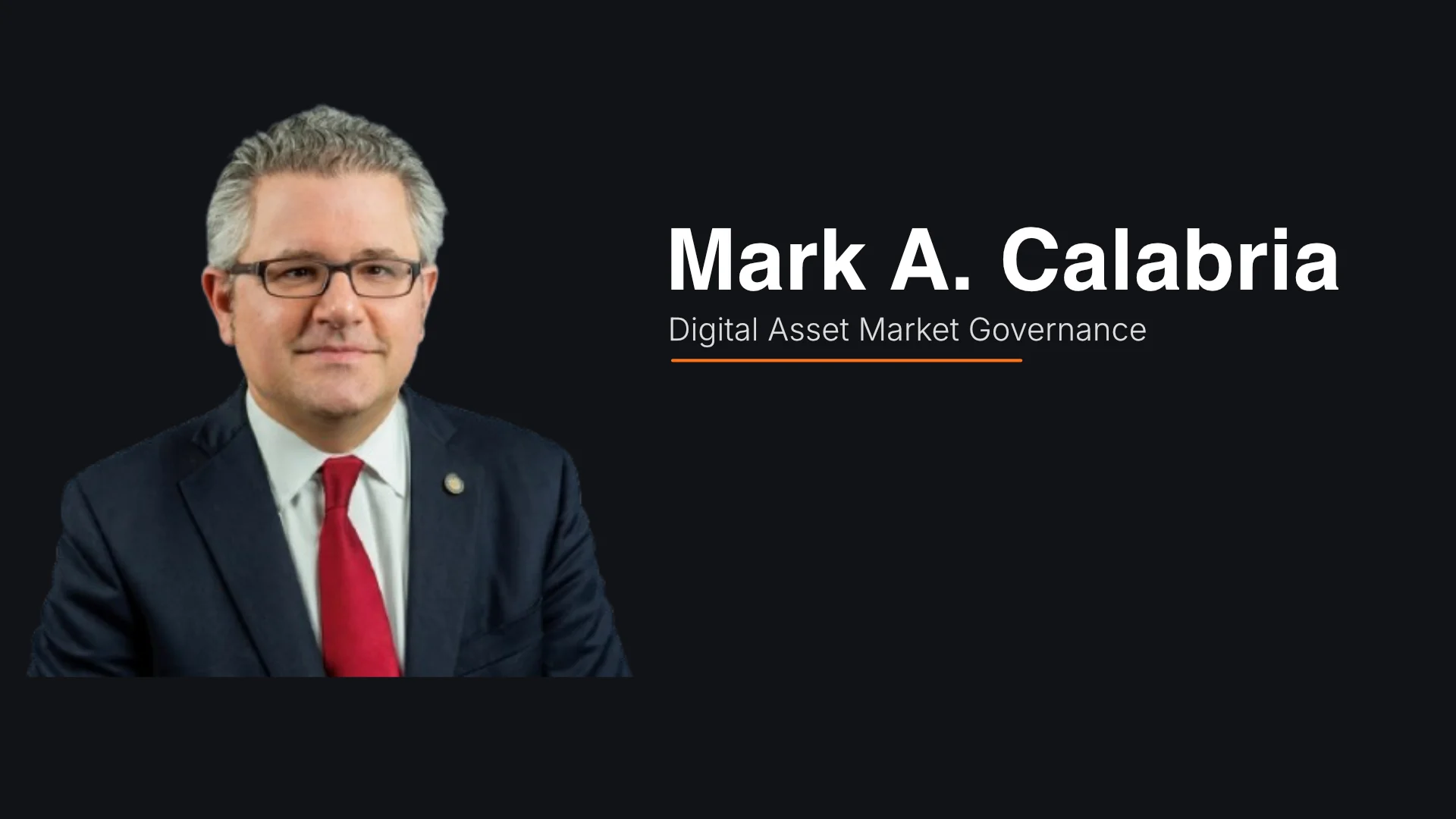
Dr. Mark A. Calabria is a Board Member at the Public Company Accounting Oversight Board. He previously served as Director of the U.S. Federal Housing Finance Agency and has held senior roles across financial regulation, banking policy, and economic governance, including at the U.S. Senate Committee on Banking, Housing, and Urban Affairs.
In this interview with CryptoMegaphone, Calabria discusses governance failures in financial markets, the role of disclosure and leverage in periods of economic stress, and the conditions required for digital asset markets to become a durable component of the broader financial system. He also examines transparency, auditability, and the relationship between regulatory structures, market integrity, and innovation.
You have worked at the intersection of financial policy, market oversight, and crisis management. Which governance failures seen in traditional finance are most important for digital asset markets to avoid repeating?
When governance structures work well, they facilitate the free flow of communication and incorporate diverse, and sometimes competing, perspectives. Where I have witnessed the most significant failures are in environments where leadership was not open to criticism or skepticism.
Markets operate most efficiently when leadership is responsive to critique and evolving conditions, rather than insulated from skepticism. Successful organizations therefore need governance mechanisms that facilitate continual testing of assumptions, helping markets self-correct and reducing the risk of consensus-driven distortions. Leading up to the 2008 financial crisis, for instance, there was a broad assumption that house prices only moved higher, at least in nominal terms.
For digital asset markets, fostering transparency around volatility and risk is essential to allowing participants to make informed decisions and allocate capital efficiently. A well-functioning market does not require uniform optimism. Rather, it benefits from a balance of support and informed skepticism that strengthens price discovery and long-term resilience.
Market confidence is often discussed as sentiment, yet in practice it is built through institutional design. Which elements—disclosure, controls, incentives, supervision, or enforcement—matter most in creating durable trust?
One of my former bosses, then-Banking Committee Chair Senator Richard Shelby, liked to say that “confidence comes from competence,” illustrating that confidence based solely on sentiment is fragile. Strengthening confidence in digital asset markets depends on the interaction of disclosure, controls, incentives, supervision, and enforcement.
Accurate, timely, and relevant disclosure is needed to give investors confidence. Over the last several years, digital asset markets have evolved from investors basing decisions primarily on momentum and expectations of price appreciation toward a greater focus on fundamentals. That shift will change the type of information demanded by investors and create additional complexities for regulators.
Having navigated periods of economic stress, what distinguishes firms that appear strong in benign conditions from those that remain resilient when liquidity and confidence deteriorate?
Fundamentally, it is leverage. The temptation to magnify gains on the way up can quickly turn into a magnification of losses on the way down. Firms that remain durable through periods of stress tend to be more disciplined in how they deploy leverage and are better positioned to absorb volatility.
From a financial stability perspective, I am less concerned about the underlying value of digital assets themselves and more concerned about transactions that leverage those assets. It is the structure of those exposures, not asset prices alone, that determines how stress is transmitted through the system.
It is also critical for investors to receive accurate information regarding that leverage, particularly the degree to which it is fully reflected in a firm’s balance sheet.
As markets become increasingly digital and data-intensive, how should transparency and auditability evolve to keep pace with new forms of financial intermediation?
I believe increasing data intensity will facilitate greater transparency. It will become easier for third parties, including auditors and market participants, to verify ownership of assets and track transactions.
As access to information broadens, verification becomes more decentralized and increasingly driven by market demand. Of course, questions around audit evidence will continue to evolve, and I hope that, where necessary, standard setters will provide guidance.
For instance, when an auditor is theoretically able to examine the universe of an issuer’s transactions, it raises fundamental questions about what role sampling should continue to play.
Policy debates frequently frame innovation and regulation as competing forces. In your view, what does a well-functioning regulatory architecture look like when the objective is both market dynamism and market integrity?
Regulatory structures that work well should facilitate innovation rather than constrain it. When risks are transparently disclosed, investor confidence should strengthen, increasing the capital available for innovation and capital formation.
The regulatory architecture should also help foster an environment that is robust to the inevitable failures that accompany innovation. That is a point I want to emphasize. An appropriate regulatory framework is not one that seeks to eliminate failure or risk altogether. It is one that recognizes failure as an inherent part of innovation.
Ultimately, the goal is the alignment of incentives between those taking risks and those bearing the downside of those risks.
What developments over the next several years would most convincingly indicate that digital asset markets are becoming a durable component of the broader financial system rather than a parallel ecosystem?
I think we are actually getting quite close to that point. Continued and greater participation by mainstream financial institutions in digital asset markets is certainly key.
Ultimately, however, broader acceptance will depend on the ability of digital asset markets to withstand a market downturn. Mainstream investors and institutions need confidence that digital asset markets can remain robust and resilient through periods of stress.
So, while I am not expecting or hoping for it, a demonstrated ability to weather cycles will be key to establishing long-term credibility.
Dr. Mark A. Calabria is a Board Member at the Public Company Accounting Oversight Board. The views expressed here are his own and do not necessarily reflect the views of the PCAOB, other PCAOB Board Members, or PCAOB staff.