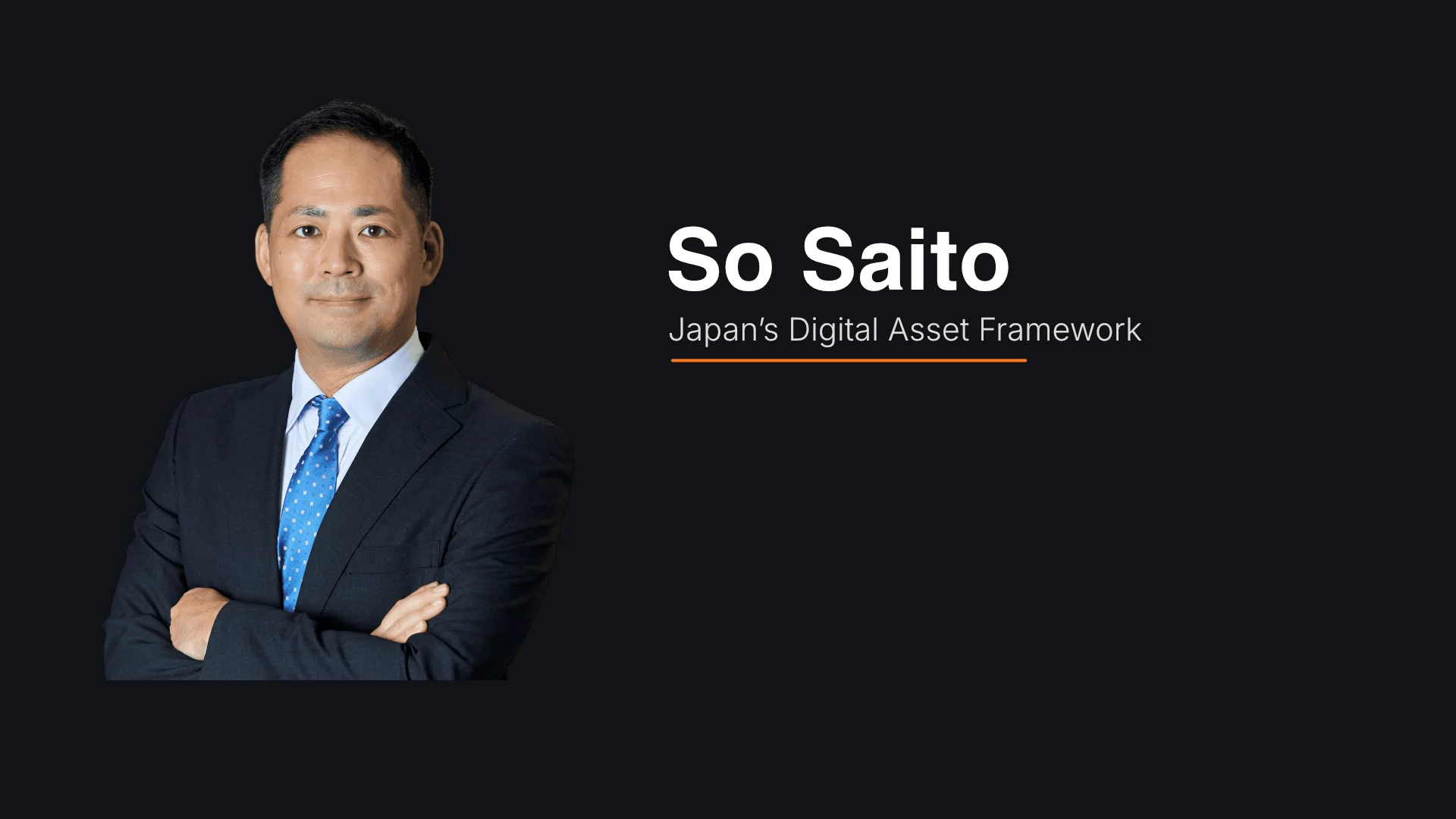
So Saito is the founding partner of So & Sato Law Offices, a boutique Japanese law firm focused on Web3, fintech, startups, investment funds, and M&A. Prior to founding the firm, he spent 16 years at one of Japan’s largest law firms, where he advised on finance-related matters including securitization, derivatives, and fund structures. He advises clients on crypto asset exchange registration, stablecoin regulation, tokenization, DeFi, custody, crypto derivatives, and digital asset regulatory compliance in Japan, and serves as a legal advisor or officer to several blockchain, fintech, and digital asset industry associations.
In this interview with CryptoMegaphone, Saito discusses the structure of Japan’s digital asset regulatory framework, the evolution of stablecoins and tokenized financial products, and the regulatory distinctions between Japan, the United States, and the European Union. He also examines institutional market development, operational compliance risk, custody and governance challenges, and the legal and structural conditions underpinning long-term institutional participation in digital asset markets.
Japan’s evolving digital asset framework is often viewed as more operationalized than many Western jurisdictions. From your perspective, what structural characteristics distinguish the Japanese regulatory approach to crypto assets today?
Japan’s approach to crypto asset regulation is characterized by the early establishment of an operational framework combining a registration system, user protection requirements, AML/CFT compliance, and industry self-regulation. Rather than placing crypto assets outside the regulatory perimeter, Japan integrated them into its existing financial and payment services framework, allowing the market to develop under regulatory oversight.
Unlike the United States, where regulatory boundaries have often been shaped through litigation and enforcement, Japan has prioritized statutory frameworks, supervisory oversight, and self-regulatory mechanisms. Japan has also not adopted a unified crypto-specific regime comparable to the EU’s MiCA. Instead, crypto assets, stablecoins, and security tokens have been incorporated into existing legislation — principally the Payment Services Act and the Financial Instruments and Exchange Act — according to their respective characteristics.
This approach promotes consistency with broader financial regulation while allowing policymakers to respond within established legal categories. The trade-off, however, is a degree of structural complexity across the overall regulatory landscape.
In summary, Japan’s framework is neither particularly permissive nor simplistic. It is better understood as conservative but not hostile to digital assets — an approach focused on defining how these assets fit within the existing financial and payments infrastructure.
Japanese regulators have gradually expanded pathways for stablecoins, tokenized financial products, and institutional digital asset activity. Which areas of the current framework appear most significant for institutional market development over the coming years?
From the perspective of institutional market development, I would highlight three priority areas over the coming years: first, the regulatory infrastructure surrounding investment products, including potential crypto asset ETFs; second, tokenized financial products; and third, custody and broader market infrastructure development.
For crypto assets to function as institutional investment assets, the frameworks governing disclosure, market integrity, investment advisory and management activities, distribution, and insider trading will need to continue evolving. Transitioning from a retail-dominated trading environment to one in which institutional investors can participate meaningfully requires more than simply permitting transactions — it requires the levels of reliability and transparency associated with established financial markets.
Security tokens and tokenized financial products also represent a comparatively accessible entry point for institutional investors. The tokenization of existing financial instruments — including real estate, bonds, and fund interests — provides a practical bridge between digital asset markets and traditional finance. In this respect, the discussion is likely to shift from “crypto assets themselves” toward how digital assets can be embedded within the infrastructure of established financial markets.
Cross-border regulatory fragmentation remains a major challenge for digital asset firms operating internationally. How do you assess the current level of alignment — or divergence — between Japan, the United States, the European Union, and other major jurisdictions?
At a broad level, I believe policy priorities across major jurisdictions are gradually becoming more aligned. On issues such as user protection, AML/CFT, custody, stablecoin regulation, and market integrity, Japan, the United States, the European Union, and other major jurisdictions are increasingly focused on similar concerns.
That said, the underlying regulatory architecture remains considerably fragmented. The EU has adopted a comprehensive crypto-specific framework through MiCA, while Japan has pursued a more integrative approach by embedding digital assets within the Payment Services Act and the Financial Instruments and Exchange Act. In the United States, the interaction among securities regulation, commodities regulation, state law, and ongoing federal market structure discussions remains highly complex.
To some extent, this fragmentation is structurally unavoidable. Digital assets move globally, but the underlying frameworks governing securities, payments, insolvency, taxation, and financial regulation remain fundamentally jurisdiction-specific. For internationally operating firms, this divergence creates a substantial compliance burden. For the foreseeable future, businesses will likely need to structure operations around jurisdiction-specific requirements rather than assume convergence toward a unified global standard.
As digital asset businesses mature, legal scrutiny increasingly extends beyond token classification toward governance, compliance controls, custody, and operational resilience. Which areas of legal exposure do you believe firms continue to underestimate most frequently?
The area firms most consistently underestimate is not token classification itself, but the ongoing compliance obligations that arise once a business becomes operational. Many projects initially focus heavily on threshold questions — such as whether a token constitutes a security or whether a particular activity qualifies as a crypto asset exchange business — yet, in practice, post-launch operational compliance often presents the greater legal risk.
Particular areas of concern include custody arrangements, client asset management, advertising and solicitation practices, conflicts of interest, outsourcing oversight, and cybersecurity. A firm may take the position that it is not providing custody services, but if it is effectively involved in transferring client assets or managing private keys, regulatory exposure may still arise.
Similarly, in Web3 projects that are nominally decentralized, founders, foundations, development companies, and principal investors frequently retain substantial practical influence. Regulators are likely to place increasing scrutiny on these substantive governance structures over time.
Cross-border regulatory exposure is also frequently underestimated. Where a firm provides services to Japanese residents from outside Japan, or where a Japanese firm targets users in foreign jurisdictions, domestic compliance alone is insufficient. In the digital asset sector, legal risk must be assessed holistically — taking into account service design, user location, solicitation methods, and the manner in which assets are held and managed.
Institutional participation in digital assets continues to expand globally despite ongoing regulatory uncertainty in some jurisdictions. In your view, what legal or structural conditions are most important for sustaining long-term institutional confidence in the sector?
Sustaining long-term institutional confidence requires clarity of legal classification, reliable custody infrastructure, client asset segregation, adequate disclosure standards, and transparent price formation mechanisms. For institutional investors, the relevant question is not simply whether an asset is financially attractive, but whether investment exposure can be justified within fiduciary duty frameworks and internal governance requirements.
Custody and insolvency remoteness are particularly critical. In the digital asset context, failures in private key management, cybersecurity breaches, operational errors, and custodian counterparty risk can result in direct asset loss. For institutions to participate with confidence, it must be clear where assets are held, who controls them, and how they are protected in the event of custodian insolvency.
Tax, accounting, and audit frameworks are equally indispensable. Even where an asset is legally permissible as an investment, uncertainty surrounding accounting treatment or auditability may deter institutional investors and listed companies from meaningful participation. Ultimately, long-term confidence is sustained not by a permissive regulatory environment, but by a market structure in which risks can be measured, managed, and communicated clearly to both internal and external stakeholders.
Looking ahead, which regulatory or market structure developments do you believe could most materially shape the next phase of digital asset adoption in Japan and internationally?
Looking ahead, the developments most likely to shape the next phase of digital asset adoption include the regulatory infrastructure for investment products such as crypto asset ETFs, the practical utility of stablecoins, the growth of tokenized financial products, and greater regulatory clarity surrounding DeFi, staking, and custody.
In Japan, the foundational frameworks for stablecoins and security tokens are already meaningfully established. The central question now is not whether these frameworks exist, but whether financial institutions, payment service providers, corporates, and Web3 businesses will actively build upon them. In particular, the extent to which yen-denominated stablecoins and tokenized financial products become integrated into payment flows, capital markets activity, and broader commercial infrastructure will be highly consequential.
Internationally, I expect the market to gradually move away from treating digital assets as a category separate from conventional finance and toward integrating them within existing financial, payments, and capital markets infrastructure. In Japan as well, if crypto asset ETFs, institutional custody solutions, tokenized financial products, and stablecoin payments develop in parallel, digital assets are likely to evolve from a primarily speculative asset class into a broader component of financial infrastructure.