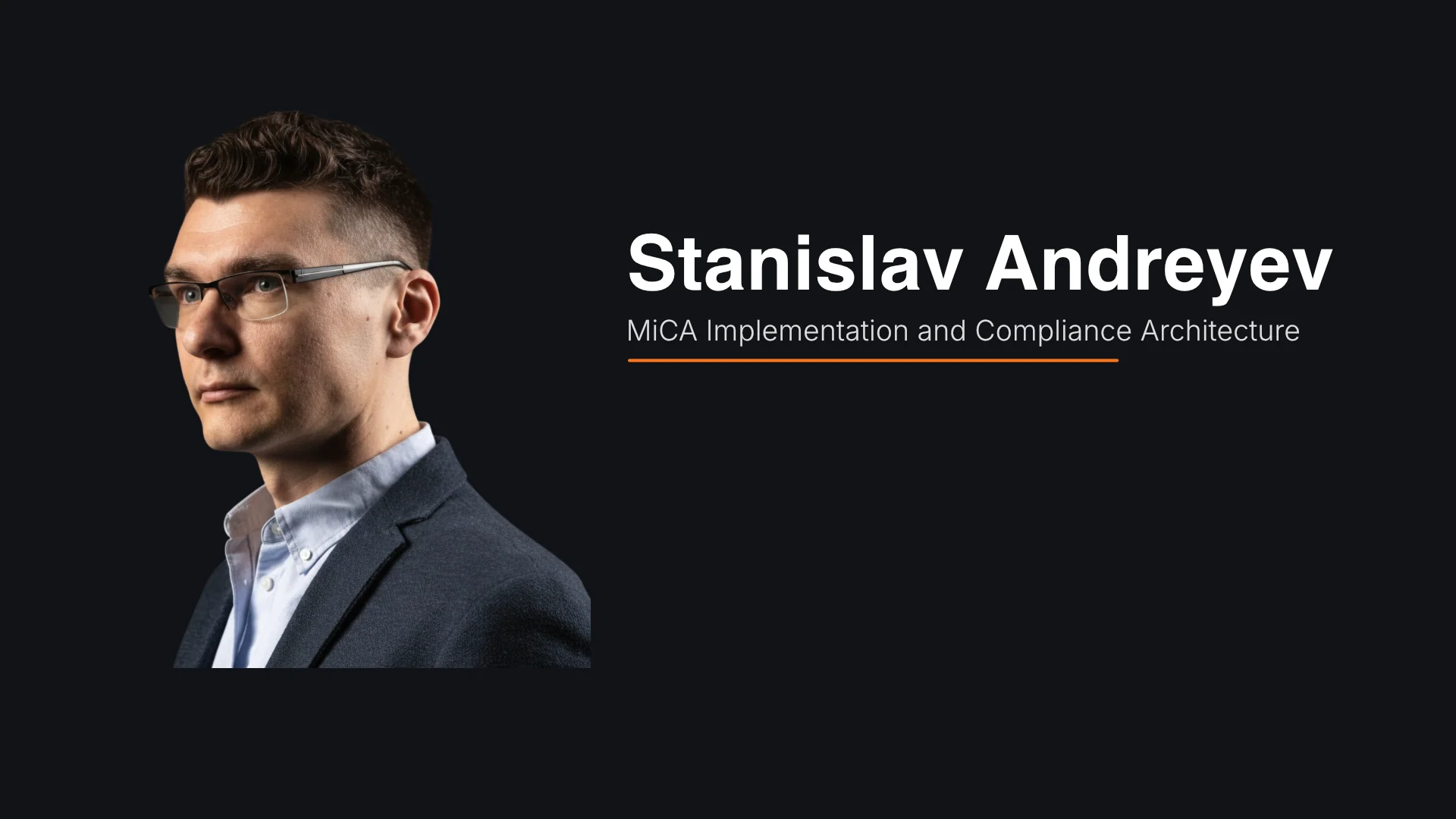
Stanislav Andreyev, a crypto lawyer and Certified Anti-Money Laundering Specialist (CAMS), advises digital-asset firms on regulatory compliance, financial crime prevention, and digital securities frameworks. He runs a private AML advisory practice supporting Web3, DeFi and fintech clients navigating evolving global regulatory requirements.
In this interview with CryptoMegaphone, Andreyev discusses the operational realities of implementing the European Union’s Markets in Crypto-Assets (MiCA) regulation, including the convergence of legal and technical compliance, Travel Rule integration under the Transfer of Funds Regulation (TFR), and the supervisory challenges facing crypto-asset service providers across the European Economic Area.
The distinction between legal and technical challenges appears to be narrowing in digital asset compliance. In practice, where does this convergence most visibly surface during MiCA implementation?
The honest answer is that the distinction was always somewhat artificial. What MiCA has done is make this impossible to ignore. The regulation speaks in legal concepts — “orderly wind-down,” “adequate arrangements,” “fair treatment of clients” — but the competent authority reviewing your application does not want a legal essay. They want to see how your systems enforce those concepts. The convergence surfaces most acutely in three areas.
First, transaction monitoring under the Transfer of Funds Regulation (TFR) recast. The legal obligation is straightforward: identify, verify, and transmit originator and beneficiary information. But “transmit” in a blockchain context immediately becomes a question of technical architecture. Are you running an interVASP messaging protocol? Which one? How does it interact with your on-chain analytics layer? The legal team writing the policy and the engineering team building the infrastructure must design against the same specification. In many firms going through licensing, they did not. The policy says one thing; the system does something structurally different.
Second, custody segregation. MiCA Article 70 and the associated RTS on safekeeping impose obligations that sound like legal requirements but are, at their core, wallet architecture decisions. Segregation of client assets “at all times” means your hot- and cold-wallet topology, key-management ceremony, and reconciliation logic must reflect that legal commitment. I have reviewed arrangements where legal documentation claimed full segregation, but the on-chain structure relied on omnibus wallets with internal ledger tracking. That creates a control gap that contractual language cannot fix.
Third, governance requirements under Article 68. MiCA requires management-body members to demonstrate adequate knowledge and competence. For CASPs, this does not simply mean understanding financial regulation. Regulators increasingly expect board-level fluency in how the platform’s technology actually works — consensus mechanisms, smart-contract risk and oracle dependencies. If your board cannot articulate the architecture it governs, the application becomes weak regardless of how strong the legal drafting is.
The convergence is no longer a trend. It is the baseline condition. Firms that still run legal and technical compliance as separate workstreams often produce documentation that does not hold together under supervisory scrutiny.
Regulators increasingly articulate expectations in outcome-based terms. How should firms translate those obligations into concrete infrastructure decisions without over-engineering or under-scoping controls?
Outcome-based regulation is attractive in theory and treacherous in practice. The regulator says “ensure effective monitoring,” but does not prescribe the tool, the threshold, or the exact system configuration that satisfies that requirement. This flexibility is deliberate, but it leaves firms guessing. Guessing usually produces two failure modes: over-engineering or minimal compliance.
The most effective approach is to reverse-engineer from the supervisory conversation. Imagine an NCA examiner sitting across from your compliance officer eighteen months from now. The examiner will not ask whether you purchased the most expensive transaction-monitoring software. They will ask how you detect structuring across wallets, how sanctions screening exceptions are handled, and how quickly you can freeze an account when instructed by authorities.
From there, firms can map each MiCA obligation to the supervisory question it will likely generate and design infrastructure accordingly. Transaction monitoring, for example, must allow on-chain clustering data to be cross-referenced with internal KYC records close to real time. Whether that is achieved through Chainalysis, Elliptic, an internal model, or a hybrid solution matters less than the ability to demonstrate clear investigative outcomes.
Where firms over-engineer is usually in trying to automate regulatory judgment calls that supervisors expect humans to review. Fully automated suspicious activity reporting is a good example. Conversely, firms under-scope Travel Rule compliance by focusing only on data transmission while neglecting exception handling for unhosted wallets or non-responsive counterparties.
Proportionality ultimately becomes the design principle. A CASP processing hundreds of transactions daily does not need the same infrastructure as one processing hundreds of thousands. But both must demonstrate that their controls are calibrated to their risk profile and that this calibration is documented and defensible.
As TFR requirements intersect with on-chain monitoring, what architectural misalignments most commonly emerge during implementation?
The Travel Rule is where implementation discipline most often breaks down. Many firms treat it as a compliance add-on instead of an integral part of the transaction lifecycle. In reality, TFR compliance must be embedded at the transaction-initiation stage.
A common misalignment occurs between the messaging layer and the settlement layer. Under the recast TFR, originator and beneficiary data must be transmitted alongside or ahead of the crypto-asset transfer. In practice, this means the interVASP messaging protocol — whether TRISA, OpenVASP, TRP, or another solution — must integrate directly with the transaction-signing workflow.
In many implementations these processes run in parallel. Compliance triggers the data exchange while operations execute the blockchain transaction independently. This creates edge cases where the transfer settles on-chain before the receiving CASP confirms receipt of Travel Rule data, which regulators view as a sequencing failure.
Another challenge arises with unhosted wallet transfers. Firms often build systems for the CASP-to-CASP scenario and treat unhosted wallets as an exception. In practice, unhosted wallets frequently represent a significant share of activity. When the architecture is not designed to accommodate this reality, exception queues quickly overwhelm compliance teams.
Address attribution creates a further complication. Attribution databases provide probabilistic rather than definitive identification of counterparty VASPs. When attribution fails, some firms block the transaction entirely, while others default to treating the transfer as unhosted. Both approaches can generate friction or unnecessary due-diligence obligations.
The key solution is architectural discipline. Travel Rule data exchange should be a precondition to settlement, and the logic tree for unhosted wallets and attribution failures must be engineered as rigorously as the standard transaction path.
Supervisory tolerance across European jurisdictions appears to be tightening. How should compliance teams approach control design while regulatory expectations continue to evolve?
We are currently in a transitional phase. MiCA allows Member States to extend legacy regimes until mid-2026, and those regimes differ significantly. Some jurisdictions already enforced strict standards under national frameworks, while others operated lighter systems. As the transitional period closes and ESMA pushes supervisory convergence, these differences will narrow.
For compliance teams, the primary risk is not simply tighter standards but uneven tightening. Expectations may shift through supervisory dialogue, guidance papers, or inspection questions rather than formal rule changes.
My recommendation is a strategy I call calibrated conservatism. Firms should design controls to the strictest credible interpretation of MiCA while maintaining modular architecture that allows scaling back if supervisory consensus stabilizes at a lower threshold.
Practically, that means implementing segregation at the wallet level rather than relying solely on ledger tracking, incorporating the most granular AML typologies into risk assessments, and drafting internal governance policies that exceed minimum regulatory language. Having structural headroom is far preferable to renegotiating internal frameworks under supervisory pressure.
Effective MiCA implementation requires coordination between legal interpretation and technical execution. What does a well-functioning cross-functional compliance structure look like in practice?
Successful implementations share one characteristic: legal, compliance, and engineering teams operate on a shared project cadence rather than sequential hand-offs.
The regulatory lawyer interpreting governance obligations should be present in the same sprint planning sessions as the engineers building role-based access controls. Similarly, AML officers defining due-diligence triggers should review the same decision-tree logic that data engineers implement in code. Shared cadence produces shared vocabulary, and shared vocabulary prevents policy and infrastructure from diverging.
Friction usually arises in three areas. The first is sequencing. Legal teams prefer to finalize interpretation before engineering begins development, while engineers prefer a stable specification before committing resources. Because MiCA implementation contains inherent ambiguity, parallel workstreams with regular synchronization are the only viable approach.
The second issue is ownership of the compliance control catalogue. Policies, procedures, and technical controls are often maintained by different teams with no single function responsible for mapping them together. Increasingly, firms are introducing compliance-architecture roles to bridge this gap.
The third issue is testing. Legal deliverables are rarely stress-tested in the same way technical systems are. Firms that run scenario exercises against regulatory policies — essentially unit tests for compliance frameworks — consistently produce stronger supervisory outcomes.
As MiCA moves from legislative framework to full supervisory application, where do you expect the most significant implementation challenges to emerge over the next 12 to 18 months?
Three areas stand out.
First is the transitional cliff. Several Member States established transitional deadlines clustered around mid-2026. Firms that relied heavily on grandfathering provisions without progressing their authorization applications will soon face a binary outcome: licensed or forced to exit the market. This may trigger consolidation, acquisitions, or relocation attempts.
Second is supervisory divergence in the interpretation of MiCA’s secondary legislation. Even after ESMA finalizes technical standards, national competent authorities will apply them through local supervisory judgment. Divergent classification of hybrid tokens under the MiCA taxonomy is already emerging as a practical issue.
Third is the boundary between centralized services and decentralized finance. MiCA intentionally leaves DeFi largely outside its scope, but hybrid models complicate that distinction. Platforms operating centralized interfaces connected to decentralized liquidity or protocols may face complex questions about where regulatory obligations begin and end.
Ultimately, the first year of MiCA’s full application will be shaped less by the text of the regulation and more by the supervisory culture that develops around it. Firms that build adaptive compliance architectures — capable of evolving alongside supervisory expectations — will be better positioned than those treating MiCA as a one-time compliance exercise.