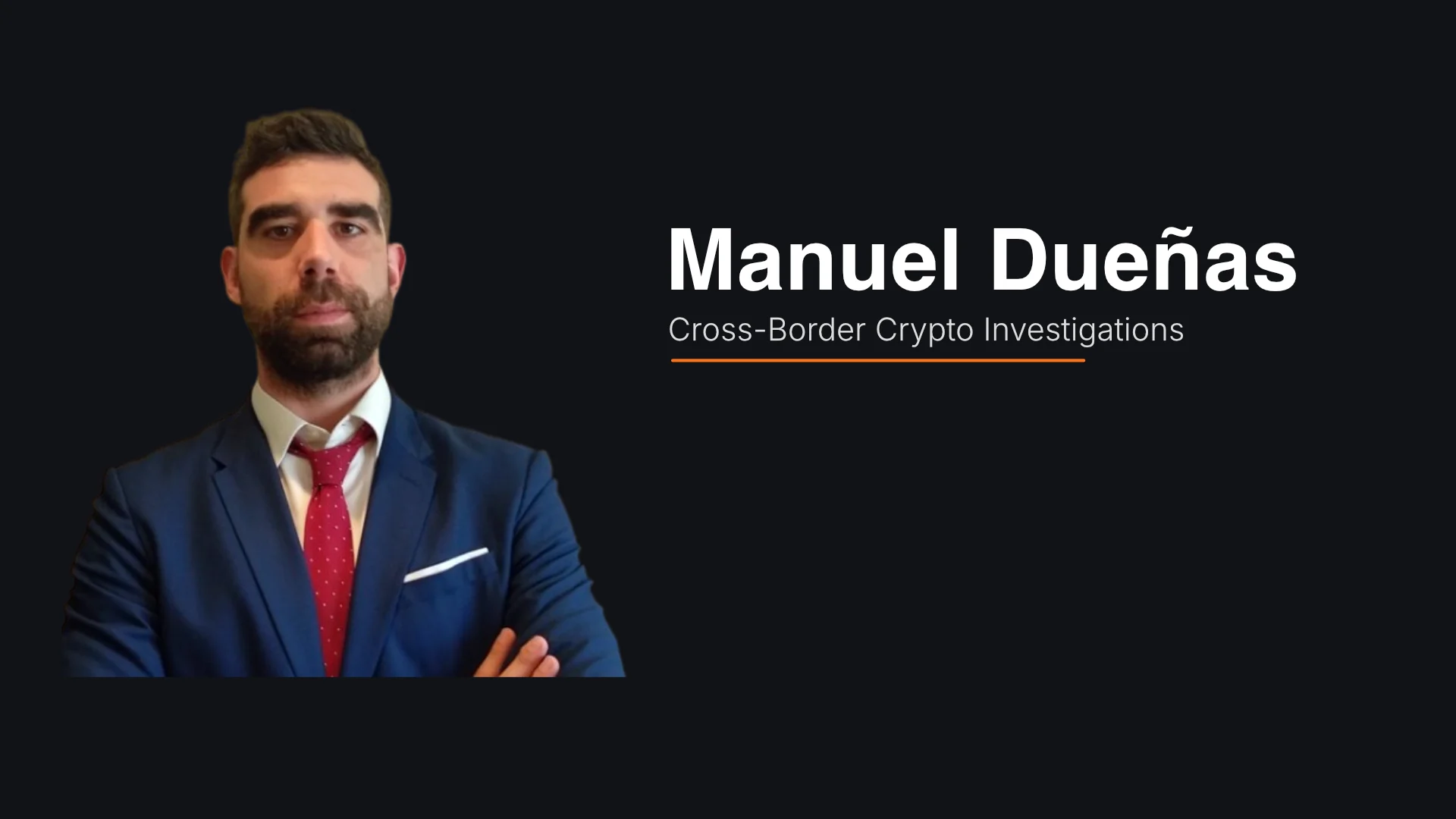
Manuel Dueñas, Senior Fraud Lawyer at Crypto Legal, advises clients on cryptocurrency fraud, blockchain forensics, digital asset tracing, anti-money laundering compliance, and cross-border recovery matters involving blockchain-based financial activity. He works on matters involving crypto-related disputes, forensic investigations, asset tracing, and regulatory challenges associated with digital assets across multiple jurisdictions.
In this interview with CryptoMegaphone, Dueñas discusses the evolution of blockchain-based financial investigations, the operational realities of cross-border crypto asset recovery, the role of blockchain forensics in legal proceedings, and the compliance and enforcement challenges facing institutions operating in digital asset markets.
Cross-border coordination in digital asset investigations
CryptoMegaphone: Cross-border digital asset investigations frequently involve multiple exchanges, custodians, jurisdictions and evidentiary standards simultaneously. From your experience, where do the largest operational gaps currently exist in international crypto asset tracing and recovery efforts?
Manuel Dueñas: The largest operational gaps continue to arise at the intersection between jurisdiction, speed and cooperation. Blockchain transactions themselves are borderless and immediate, whereas legal systems remain territorial, procedural and comparatively slow-moving. In practice, this creates significant friction during the early stages of investigations, particularly when digital assets move rapidly across multiple service providers and jurisdictions within hours or even minutes.
One of the most persistent issues is the lack of harmonisation in how different jurisdictions classify and treat digital assets from both a legal and evidentiary standpoint. Certain jurisdictions now recognise crypto assets as property and permit injunctive relief, disclosure orders or proprietary tracing claims, while others still lack any clear legal framework at all. This inconsistency complicates recovery efforts considerably, especially where assets transit through exchanges or custodians operating across several regulatory environments simultaneously.
Another major challenge concerns intermediary responsiveness. Some virtual asset service providers have developed robust compliance and investigative frameworks and cooperate efficiently with legitimate legal requests. Others remain operationally opaque, underregulated or intentionally unresponsive, particularly in offshore jurisdictions. In many cases, by the time disclosure requests are processed, assets have already been fragmented, bridged or transferred through layering mechanisms designed to frustrate tracing efforts.
There is also a notable gap between technical tracing capabilities and institutional readiness. Blockchain forensic tools have become exceptionally sophisticated, but many enforcement bodies, regulators and even judicial institutions still lack the specialised expertise required to interpret complex on-chain activity confidently. The technical evidence may exist, but operationally, there is often insufficient infrastructure or expertise to act on it quickly and effectively.
Finally, coordination between private investigators, lawyers, exchanges and law enforcement remains fragmented internationally. Successful recovery increasingly depends on rapid multi-party collaboration, yet there is still no universally streamlined framework for urgent digital asset preservation and disclosure across borders.
Blockchain forensics and evidentiary standards
CryptoMegaphone: Blockchain analytics and forensic tools have advanced significantly in recent years, but legal proceedings still require evidentiary standards that differ across jurisdictions. How are courts and investigators adapting to blockchain-based evidence, and what challenges remain in establishing reliable attribution in digital asset cases?
Manuel Dueñas: Courts and investigators have unquestionably become more sophisticated in their understanding of blockchain evidence over the past several years. In many major jurisdictions, blockchain analytics reports, wallet tracing evidence and transaction clustering methodologies are now regularly relied upon in both civil and criminal proceedings. Judges are increasingly comfortable engaging with forensic reports that would have been considered highly technical or novel only a few years ago.
That said, the principal challenge remains attribution rather than tracing. Establishing that assets moved from one wallet to another is generally straightforward from a forensic perspective. The more difficult question is establishing who ultimately controlled or benefited from those wallets in a legally admissible manner.
Blockchain activity is pseudonymous by design. Attribution therefore depends heavily on off-chain evidence such as exchange KYC records, IP logs, device data, communication records and transactional behaviour analysis. This creates a situation where legal investigators must combine technical blockchain analysis with traditional evidentiary methods. The blockchain alone rarely tells the full story.
Another issue is the differing evidentiary thresholds between jurisdictions. Some courts readily accept probabilistic attribution models supported by forensic clustering analysis, whereas others require far more direct evidence linking an individual or entity to wallet ownership. This divergence can materially affect litigation strategy and investigative sequencing in cross-border matters.
We are also seeing increasing scrutiny surrounding the methodology and transparency of blockchain forensic analysis itself. As these reports become more influential in legal proceedings, courts understandably require investigators to explain how conclusions were reached, what assumptions were made and what limitations exist within particular analytical models. This is a positive development for the industry because it pushes forensic standards toward greater rigour and accountability.
Ultimately, blockchain evidence is becoming increasingly normalised within legal systems, but the industry still requires greater standardisation in forensic methodology, evidentiary presentation and judicial education internationally.
AML preparedness and institutional compliance exposure
CryptoMegaphone: As banks, investment firms and other financial institutions continue expanding their exposure to digital assets, how do you assess the current state of AML and transaction-monitoring preparedness across the sector, and are there particular compliance weaknesses or investigative patterns that continue to appear in institutional digital asset cases?
Manuel Dueñas: Preparedness varies substantially across the sector. Certain major institutions have invested heavily in blockchain analytics integration, transaction monitoring infrastructure and digital asset compliance expertise. Others are still adapting legacy AML frameworks that were originally designed for traditional banking environments and are not always effective when applied to blockchain-based financial activity.
One recurring issue is overreliance on static risk models. Blockchain ecosystems evolve extremely quickly, particularly in relation to decentralised finance, cross-chain bridges, mixers and layered transaction obfuscation techniques. Institutions that rely solely on conventional rule-based monitoring systems often struggle to identify more sophisticated laundering typologies emerging within digital asset markets.
Another weakness is fragmentation between compliance, cybersecurity and investigative departments internally. Effective crypto-related AML monitoring requires an interdisciplinary approach combining financial crime analysis, blockchain forensics, cyber intelligence and legal expertise. In practice, many institutions still operate these functions in silos, which can delay escalation and reduce investigative effectiveness.
We also continue to observe institutional underestimation of exposure to indirect digital asset risk. Even where banks do not directly offer crypto services, customers increasingly interact with digital asset platforms, stablecoins and decentralised ecosystems through traditional banking rails. As a result, exposure frequently exists indirectly through payment processing, correspondent banking relationships or corporate client structures.
In investigations involving institutional exposure, common patterns include the use of nested exchange accounts, mule networks, OTC brokers operating with inadequate compliance controls and rapid cross-chain movement designed to exploit monitoring blind spots between blockchain ecosystems.
The institutions making the greatest progress are generally those treating blockchain intelligence as a core compliance function rather than a specialist add-on. The direction of travel is positive overall, but there remains a significant gap between regulatory expectations and operational maturity across large parts of the financial sector.
Evolution of crypto-related fraud structures
CryptoMegaphone: Crypto-related fraud activity appears to have become increasingly professionalized and internationally coordinated in recent years. From a legal and investigative perspective, how has the structure of digital asset fraud evolved, particularly in larger or cross-border matters?
Manuel Dueñas: The evolution has been substantial. Several years ago, a large proportion of crypto fraud involved relatively unsophisticated schemes conducted by isolated actors. Today, many operations resemble highly organised transnational enterprises with specialised roles, infrastructure and operational compartmentalisation.
We increasingly encounter networks where distinct actors handle victim acquisition, technical infrastructure, wallet management, laundering operations and cash-out activity separately. Some groups operate with levels of sophistication comparable to traditional organised financial crime syndicates.
The international dimension has also intensified considerably. Fraud operations frequently exploit jurisdictional fragmentation deliberately, establishing infrastructure, shell entities and exchange relationships across multiple countries to complicate enforcement and recovery efforts. This makes coordination between investigators, legal professionals and international authorities significantly more important than in the past.
Social engineering tactics have evolved as well. Fraud schemes are now often supported by highly polished digital infrastructure, professional customer interfaces, fabricated regulatory documentation and sophisticated psychological manipulation campaigns. Artificial intelligence and automation are also beginning to amplify the scale and sophistication of impersonation and investment fraud activity.
From an investigative standpoint, laundering methodologies have become markedly more advanced. Fraud proceeds are now routinely transferred through multiple blockchain ecosystems, privacy-enhancing services, decentralised exchanges, cross-chain bridges and layered wallets in rapid succession. This requires investigators to move more quickly and integrate blockchain intelligence with cyber investigations and traditional financial analysis in real time.
At the same time, there has been a growing convergence between cybercrime and financial fraud. Ransomware groups, hacking networks, phishing operations and investment fraud syndicates increasingly share laundering infrastructure, OTC channels and technical facilitators. The ecosystem has become more interconnected and operationally sophisticated overall.
MiCA, AML frameworks and enforcement realities
CryptoMegaphone: European digital asset regulation is becoming more structured under MiCA and related AML initiatives. In practice, do you believe the current regulatory architecture is evolving at the same pace as the operational realities of blockchain-related financial crime and asset recovery?
Manuel Dueñas: MiCA represents an important step forward in terms of regulatory clarity and market structure within Europe. It provides a more coherent framework for licensing, consumer protection and operational oversight, which is beneficial both for legitimate businesses and for investigative transparency.
However, financial crime evolves considerably faster than regulatory systems. Criminal networks adapt rapidly to technological developments, whereas legislation necessarily moves through slower institutional and political processes. As a result, there remains an ongoing lag between regulatory architecture and operational criminal reality.
One challenge is that many high-risk activities occur outside the most directly regulated segments of the ecosystem. Decentralised finance, cross-chain infrastructure, privacy-enhancing tools and certain offshore service providers continue to create significant investigative complexity despite advances in regulation.
There is also the practical issue of enforcement consistency across member states. Even with harmonised frameworks, operational capabilities and enforcement priorities still vary considerably between jurisdictions. Effective regulation ultimately depends not only on legislative design but also on institutional capacity, technical expertise and cross-border cooperation mechanisms.
That said, we are seeing meaningful progress. Regulators, financial intelligence units and law enforcement agencies are becoming far more technically informed than they were several years ago. Collaboration between public and private sectors is also improving gradually, particularly in relation to blockchain intelligence sharing and suspicious transaction analysis.
The key challenge going forward will be ensuring that regulation remains sufficiently adaptable to evolving technologies without becoming excessively rigid or innovation-restrictive. The digital asset sector changes rapidly, and regulatory frameworks must retain the flexibility to respond accordingly.
Future infrastructure for digital asset investigations and recovery
CryptoMegaphone: Asset recovery in crypto-related matters often depends on timing, jurisdictional coordination and intermediary cooperation. Looking ahead, what legal, technological or institutional developments do you believe will be most important in improving the effectiveness of crypto-related investigations and recovery processes over the next several years?
Manuel Dueñas: Speed will remain one of the most decisive factors in successful recovery efforts. The faster investigators can identify asset flows, preserve evidence and engage relevant intermediaries, the greater the probability of meaningful recovery outcomes. Accordingly, developments that reduce procedural delay will be critically important.
From a legal perspective, greater international harmonisation concerning digital asset classification, disclosure powers and asset preservation mechanisms would significantly improve cross-border recovery capabilities. More streamlined procedures for obtaining urgent intermediary cooperation across jurisdictions could materially change recovery effectiveness.
Technologically, blockchain analytics will continue becoming more sophisticated, particularly through the integration of artificial intelligence, behavioural analysis and cross-chain intelligence capabilities. Investigators are increasingly able to reconstruct highly complex laundering pathways that would previously have been operationally impractical to analyse at scale.
We are also likely to see stronger integration between blockchain intelligence providers, financial institutions and regulatory bodies. Real-time intelligence sharing and coordinated alert systems could substantially improve early intervention capabilities in fraud and money laundering matters.
Institutionally, specialised judicial and enforcement expertise will become increasingly important. Courts, regulators and law enforcement agencies that develop dedicated digital asset capabilities will be far better positioned to respond effectively to complex blockchain-related cases.
Finally, intermediary accountability will remain central. Exchanges, custodians and service providers occupy critical positions within the recovery ecosystem. As compliance expectations continue to mature internationally, the industry will likely move toward higher standards of transparency, responsiveness and investigative cooperation. That evolution could become one of the most significant drivers of improved recovery outcomes over the coming years.