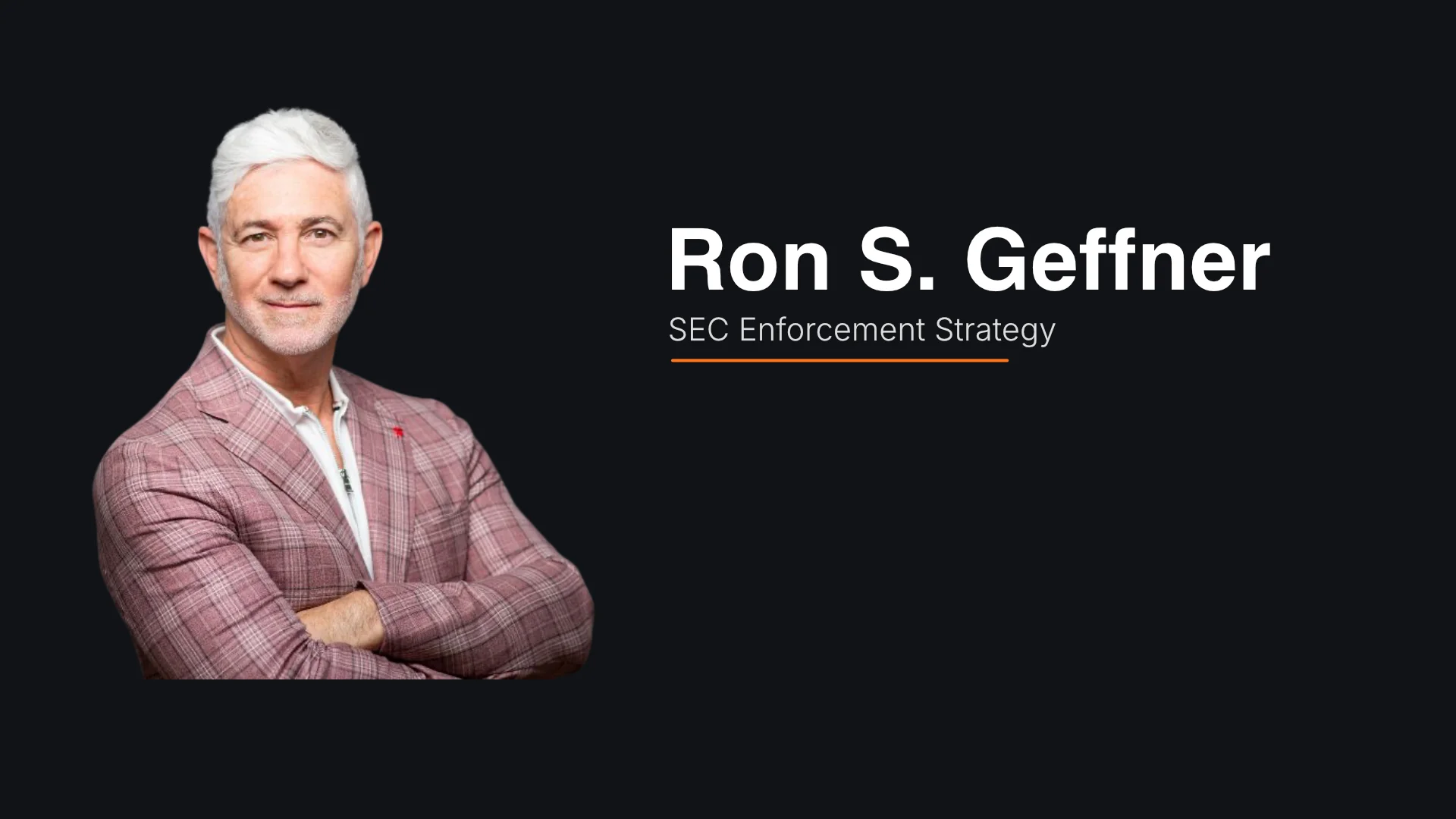
Ron S. Geffner, a partner at Sadis Goldberg LLP and a former prosecutor at the U.S. Securities and Exchange Commission, advises private equity funds, broker-dealers, commodity pool operators, and investment advisers on securities regulation, fund formation, and regulatory investigations. He represents hedge funds, venture capital funds, and other investment vehicles on matters involving U.S. securities law, market regulation, and enforcement risk.
In this interview with CryptoMegaphone, Geffner discusses the evolution of digital-asset enforcement in the United States, including the investigative approach of the U.S. Securities and Exchange Commission, coordination with regulators such as the Financial Industry Regulatory Authority and the U.S. Commodity Futures Trading Commission, and the compliance challenges facing market intermediaries operating in digital-asset markets.
How would you characterize the evolution of the SEC’s enforcement framework as applied to digital asset market participants in recent years?
The enforcement framework of the U.S. Securities and Exchange Commission with respect to digital asset market participants has evolved significantly over the past several years, reflecting both the rapid expansion of the digital asset ecosystem and the Commission’s efforts to adapt existing regulatory tools to new technologies and business models.
Early enforcement activity in the sector primarily focused on clear instances of fraud, unregistered securities offerings, and Ponzi-type schemes, many of which arose during the initial coin offering (ICO) wave. These early actions were largely reactive and were intended to signal that the federal securities laws would apply to digital asset transactions where the statutory framework required it.
As the market developed, the Commission’s approach became more structured and interpretive. The SEC increasingly articulated its views on when a digital asset may constitute a security, most prominently through the application of the Howey investment-contract analysis. This approach was reflected in enforcement actions, public statements, and interpretive materials such as the DAO Report and the Framework for “Investment Contract” Analysis of Digital Assets.
In recent years, enforcement attention has also expanded beyond token issuers to market intermediaries, including trading platforms, broker-dealers, custodians and other service providers. These actions emphasize the Commission’s view that traditional regulatory obligations relating to registration, custody, and investor protection continue to apply in digital asset markets.
Overall, the evolution of the SEC’s enforcement framework reflects an ongoing effort to apply longstanding securities law principles to a rapidly changing technological and financial environment.
What factors influence the Commission’s decision to resolve a matter through settlement as opposed to pursuing litigation in federal court?
When determining whether to resolve a matter through settlement or pursue litigation, the Commission typically considers a range of factors.
These include the strength of the evidentiary record, the likelihood of prevailing at trial, the seriousness of the alleged violations, the degree of cooperation by the parties involved, the potential deterrent value of the outcome, and the broader interests of investors and market integrity.
Practical considerations also play a role. Settlements may allow the Commission to obtain timely relief, conserve resources, and establish regulatory expectations without the uncertainty associated with protracted litigation.
How has judicial engagement in digital asset cases affected enforcement strategy, if at all?
Judicial engagement in digital asset cases has contributed to greater clarity regarding the application of existing securities laws to emerging technologies.
Court decisions interpreting how traditional statutory frameworks apply to digital asset transactions inevitably influence enforcement strategy. In some instances, judicial rulings have encouraged regulators to refine their legal theories or focus enforcement activity more narrowly.
At the same time, ongoing litigation has introduced a degree of legal uncertainty, particularly where courts have reached differing conclusions regarding the classification of certain digital asset activities.
How should market intermediaries — including trading platforms, broker-dealers, custodians, and advisers — assess enforcement exposure in connection with digital asset activities?
Market intermediaries should evaluate their digital asset activities against evolving regulatory expectations relating to custody practices, market integrity, and investor protection.
This includes assessing whether particular activities may implicate securities registration requirements, broker-dealer obligations, custody rules, or other regulatory frameworks administered by federal and state authorities. Institutions operating in the sector should also consider the adequacy of their compliance infrastructure and risk management processes in light of increasing regulatory scrutiny.
Looking ahead, what institutional developments are most likely to shape the direction of digital asset enforcement practice?
Several institutional developments are likely to influence the future trajectory of digital asset enforcement.
First, the continued development of specialized expertise within regulatory agencies will play an important role. Initiatives such as the SEC’s Strategic Hub for Innovation and Financial Technology (FinHub) and the Division of Enforcement’s Crypto Assets and Cyber Unit demonstrate an institutional commitment to building technical and market knowledge in this area.
Second, interagency coordination is expected to expand. Digital asset activities frequently implicate overlapping jurisdictions, including those of the SEC, the Commodity Futures Trading Commission, FinCEN, and state regulators. Greater cooperation among these authorities will likely shape enforcement priorities.
Third, legislative and rulemaking developments may significantly affect enforcement practice. Congressional clarification regarding the regulatory status of digital assets, as well as new rulemaking initiatives, could provide additional guidance for market participants and regulators alike.
Finally, judicial decisions will continue to shape the legal landscape. As courts interpret existing securities laws in the context of digital assets, those precedents will influence both the scope of regulatory authority and the enforcement strategies adopted by agencies.
Taken together, regulatory institutional development, interagency cooperation, legislative initiatives, and judicial interpretation will play a central role in defining the future direction of digital asset enforcement.